AI could support faster disease outbreak detection in Pacific Island Countries, stopping preventable deaths every year.
When it comes to the timeline of outbreak response, every minute and every day counts. The World Health Organisation uses the The 7-1-7 framework, developed by Resolve to Save Lives, to benchmark outbreak response worldwide, with targets of 7 days to detect a suspected outbreak, 1 day to notify authorities, and 7 days to complete early response actions. The Framework represents an innovative and significant improvement on outbreak response globally – but in the Pacific, fundamental problems remain.
What’s not working in the Pacific? Detection is largely manual, usually relying on a surveillance officer doing weekly reviews of data from sentinel sites. Syndromic surveillance occurs only from a limited number of ‘sentinel sites’ which misses many outbreaks and does not provide the statistical output to generate data signals. Notifiable diseases occur only irregularly and facilities often lack pathways for reporting. The consequences can be devastating.
As an example, Samoa’s 2019 measles outbreak was declared 16 days after its index case, already more than double the 7-day target. The outbreak went on to infect over 5,700 people and 83 people died in just four months, mostly children under five, in a population of just over 200,000. In Australia that would translate to roughly 10,375 deaths: more than our entire road toll for over eight years combined (Australia sees around 1,200 road deaths a year). In Samoa’s case, the slow start to detection left less time for effective early response that can limit outbreaks and save lives (though to be fair, measles outbreaks are notoriously difficult to respond to and local authorities did an incredible job under the circumstances and with the tools available at the time.
More often though, deadly disease outbreaks in the Pacific are of much less high-profile diseases, they’re often geographically limited to a single island or village and consequently go completely undetected. The biggest killers of children remain community-acquired pneumonia and diarrhoea.
That’s where AI can help.
Overlaying an AI data layer to existing disease detection data sources
An increasing number of countries in the Pacific are using EMRs/EHRs to record and manage every single clinical encounter in the public sector, in real-time. Samoa and Nauru are already there and other countries are catching up. Our idea is to build an AI layer on top of existing EHR tools, matched to what each country’s digitisation already looks like. The tool will support earlier outbreak detection by leveraging existing patient data, which is already being passively collected. In most cases, clinical staff will not be required to manually report anything else than information they are already collecting. The AI layer would alert authorities to disease threats in near real-time (minutes/hours, not days), enabling earlier detection, and thereby, notification, and response. In regards to infrastructure, the data pipeline, encounter records and visualisation layer already exist; the work is the AI layer, scoped specifically to detection.

Health authorities using data visualisation tool Tupaia to support decision making.
The difference BES would bring – infrastructure and relationships
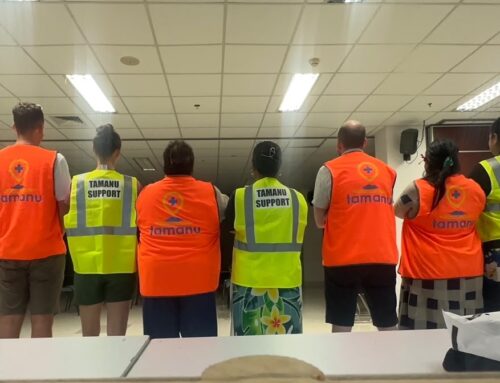
BES’s involvement will leverage our existing relationships and data infrastructure deployed in Pacific Island Countries. The infrastructure includes two of BES’s flagship products, The Tamanu Electronic Medical Record (EMR), and the Tupaia data visualisation platform. By way of introduction:
- Tamanu is the national EMR in six Pacific Island Countries
- 15 million clinical encounters have been tracked in Tamanu
- Almost 5000 healthcare workers are using Tamanu across the Pacific
- 2 million patients from Pacific Island Countries have a patient record in Tamanu
What’s the relevance of these data platforms to an AI layer? Every patient visit recorded in Tamanu is tracked live. When a cluster of patients turns up at the same clinic in a short window with the same set of symptoms – for example, fever, cough and a rash – it can be an early sign that an outbreak is underway. The AI layer watches for this: it checks incoming data against a set of pre-built thresholds and indicators, and the moment a cluster looks abnormal, it sends an automatic alert to the relevant health authorities, giving them the chance to respond before the outbreak spreads.
It still relies on local doctors and nurses capturing clinical details correctly – but the AI layer can also be trained to detect where this is not happening, enabling us to direct improved training and support.
Who would benefit the most from the AI layer?
Findings from a recent review of 84 outbreaks in Uganda found that faster detection is associated with fewer cases, fewer deaths, and shorter outbreaks. Surveillance timeliness is a determinant of outbreak impact.
With this AI layer, surveillance teams would become aware of potential outbreak risks much earlier, gaining precious time to mobilize an effective, systematic response through actions like awareness raising campaigns, contact tracing and case finding, positioning of commodities and surge staffing.
Healthcare workers would be able to react more quickly and in the best cases, reduce the impact of disease outbreaks, improving quality care, reducing the spread of transmission and saving lives.
As the response actions reached communities, people could take action to reduce their own risk, as well as seek care earlier and more easily. Patients and their communities could be diagnosed and treated more quickly and with better care, before an illness has the chance to spread widely. From there, the benefit reaches neighbouring countries and the wider region, since containing an outbreak locally reduces the risk of it crossing borders.
Nothing in the AI removes the human factor required to properly respond to disease outbreaks. Highly trained field epidemiologists, ‘surge’ staff providing clinical care, and public health communication campaigns also need support and strengthening, playing the critical role of using data in their decision making.
But AI can help a lot.
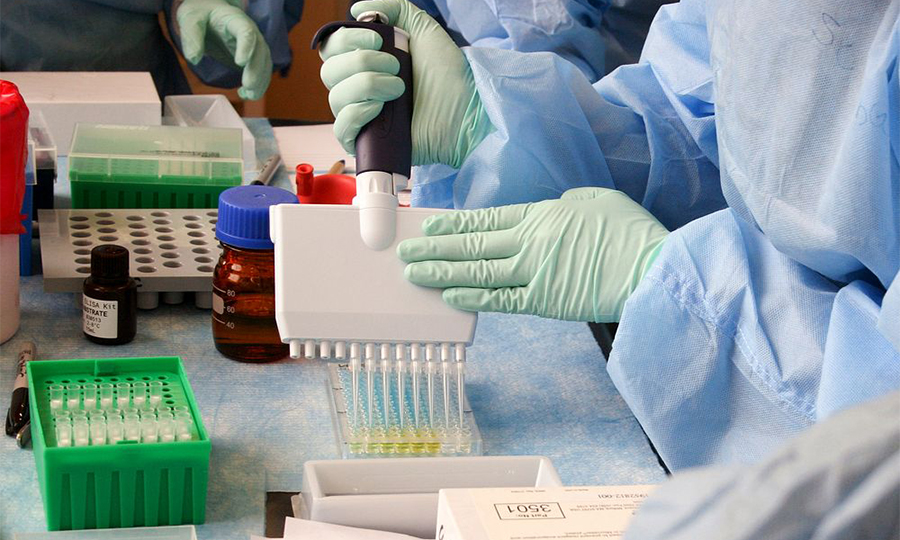
A laboratory technician adding a solution to a sample. Credit: Rawpixel.com
Next steps
Next steps could include:
- Potential partnerships to explore linkages in the Pacific, with donors and Governments
- Conducting feasibility study in a single Pacific Island Country to generate evidence for the initiative
- Conducting a pilot of the AI layer for disease surveillance in one of the countries.
- Seeking grant funding from philanthropists, Governments etc for distinct phases of the initiative, leveraging the results of the feasibility study
- Developing the AI layer with BES’s software developers and data engineers
- Seeking additional funding from Governments, philanthropy and corporations
- Scaling the initiative across nine Pacific Island Countries.
Not forgetting the bigger picture
Now that we’ve made early disease detection sound straightforward, it’s worth being upfront about the real challenges that apply to any health initiative, even more so in a low-resource setting. This isn’t a simple problem to solve. It starts with the data itself: the consistency and quality of what’s being collected in the first place. Then the build – securing the system, and the genuine complexity of programming AI to detect disease patterns reliably, whilst ensuring data integrity and sovereignty remain paramount. And then implementation – making sure the workforce has the capacity and technical skill to run it, and that the authorities receiving the alerts have the resourcing to act on them with a comprehensive, coordinated response.
Realistically, delivering this sustainably and at scale might take two to three years, and it needs real commitment from funders and partners. But the payoff – automating early outbreak detection to speed up outbreak response and contribute to minimizing preventable deaths- is worth that investment.