Support to use data for decision making

Countries have increasing access to data, but a key challenge remains in making it useful for decision makers to improve clinical services, public health programming, and overall health outcomes. We help partners strengthen their data lifecycle from data collection to quality assessment, presentation, interpretation, and practical application to solving real-world problems. This holistic approach has supported partners in disease surveillance, health system performance management, disaster and emergency response, and asset management.

A team of data experts with the best tools

We have a multifaceted team who support our data for decision making work. Our project managers – including clinical and public health experts – work with governments, development partners, and regional networks to assess data availability and gaps, and map a future state pathway.

Needs are translated into dashboards and reports by our data analysts, who are experts in transforming large datasets into actionable, visual information. Our project managers then work with local teams to apply these tools, strengthening workforce capacity to help improve health service delivery for the community.

Services

Our offering

Data for decision making review


Comprehensive data lifecycle review, including current and future state mapping. This encompasses data collection, quality assessment, presentation, interpretation, and usage. The process involves stakeholder engagement, system reviews, and development of a report outlining findings and an actionable work plan for strengthening data for decision making.

Tupaia dashboard implementation


Requirements-gathering, user training, and implementation of custom Tupaia dashboards to support actionable and automated reporting. Data sources for
Tupaia dashboards may include Tupaia DataTrak surveys, Tamanu, mSupply, and other digital health systems.

Data quality strengthening


Baseline assessment and implementation of activities to monitor digital health system data quality, identify sites or users requiring additional support, and develop a targeted action plan to improve data completeness, accuracy, and timeliness.

Tupaia

Tupaia is BES’s flagship business intelligence tool. It’s free and open-source, and is designed to sit in the middle of your systems, providing a ‘hub and spoke solution’ to data aggregation, as well collection, visualisation and mapping.

Tupaia has supported event-based, indicator-based and syndromic surveillance, and when paired with the Tamanu EMR, cohort tracking for communicable and NCDs. From tracking continuity of care and outcomes for single-condition patient cohorts, like Kiribati’s Hepatitis C program, to national-scale outbreak detection, notification and response, including Fiji, Tonga and Samoa’s COVID-19 surveillance, there are endless use cases with the Tupaia platform providing in-depth analysis.

Highlights of the Tupaia platform

  • Sits in the middle of your systems – data collection, aggregation, management, BI and mapping.
  • Customisable visualisations with powerful analysis.
  • Integrates with Tamanu, mSupply and DHIS as well as other data sources.
  • Big data capabilities with a focus on usability.
  • Disaster response, emergency operations, RDPs, supply chain and SARA all core modules.
  • Utilise tupaia.org or design a custom-built Management Information System.

A proven data eco-system in more than 12 countries

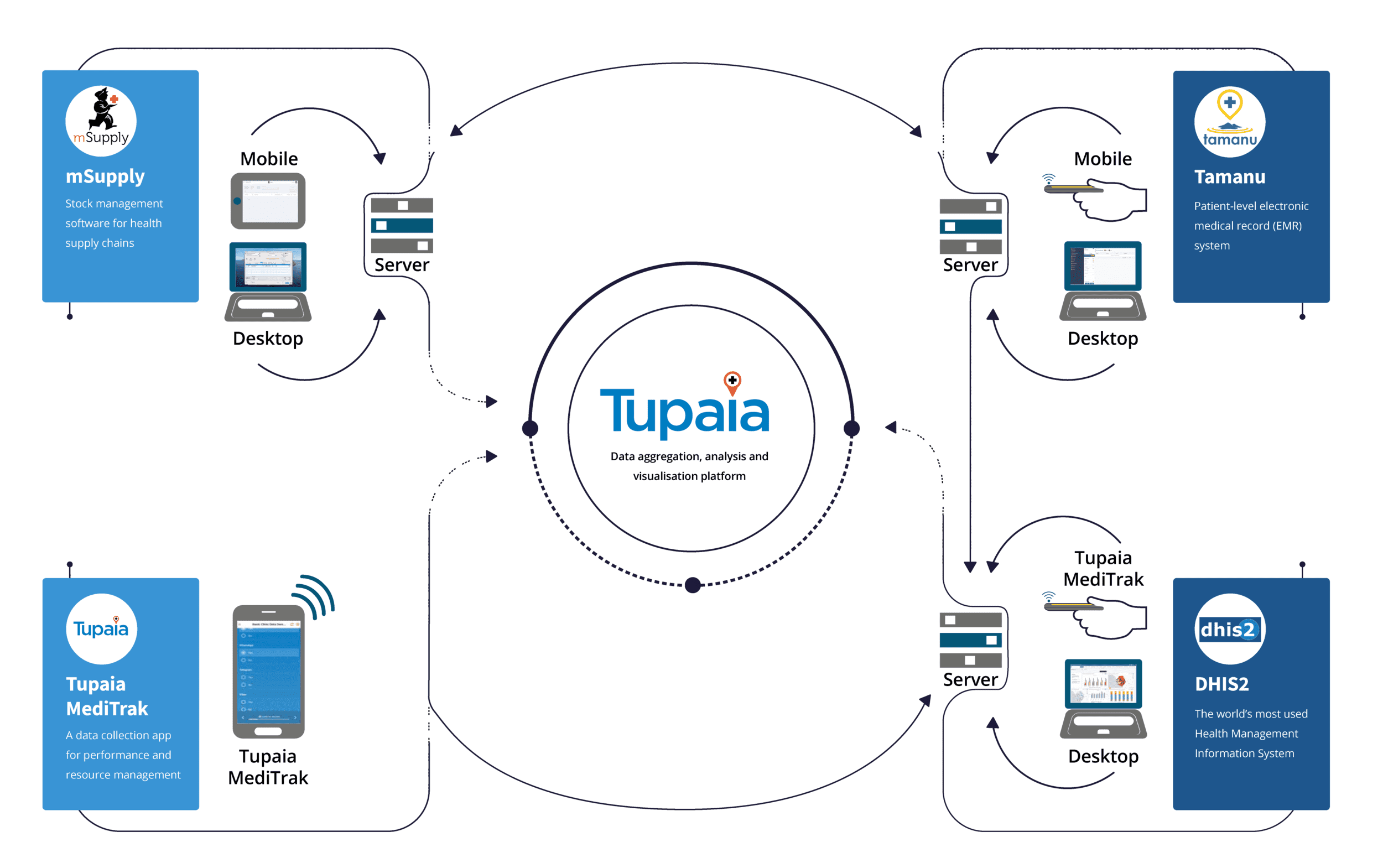
This diagram shows an eco-system often used in countries to manage the digital health system, from medicine and medical supplies, to hospital, facility and community data.

Tupaia’s offline-first mobile app is used to collect data in remote places, and has been used to support disaster preparedness and response. The Kingdom of Tonga government used Tupaia to track Cyclone Gita as it struck Tongatapu, pulling together data on commodities, staff, infrastructure and imaging to support coordination of the national emergency response.

Tupaia is integrated with BES’s implementation partners mSupply and DHIS2, and is tightly integrated with BES’s EMR Tamanu.

Data exchange using internationally accepted standards provides certainty in information sharing, access to more APIs and more powerful and faster integrations. HL7 FHIR is a data standard that defines how healthcare information is structured and exchanged between systems. At BES, we are increasingly adopting HL7 FHIR as a means of data exchange between our internal systems and externally with other providers and solutions.