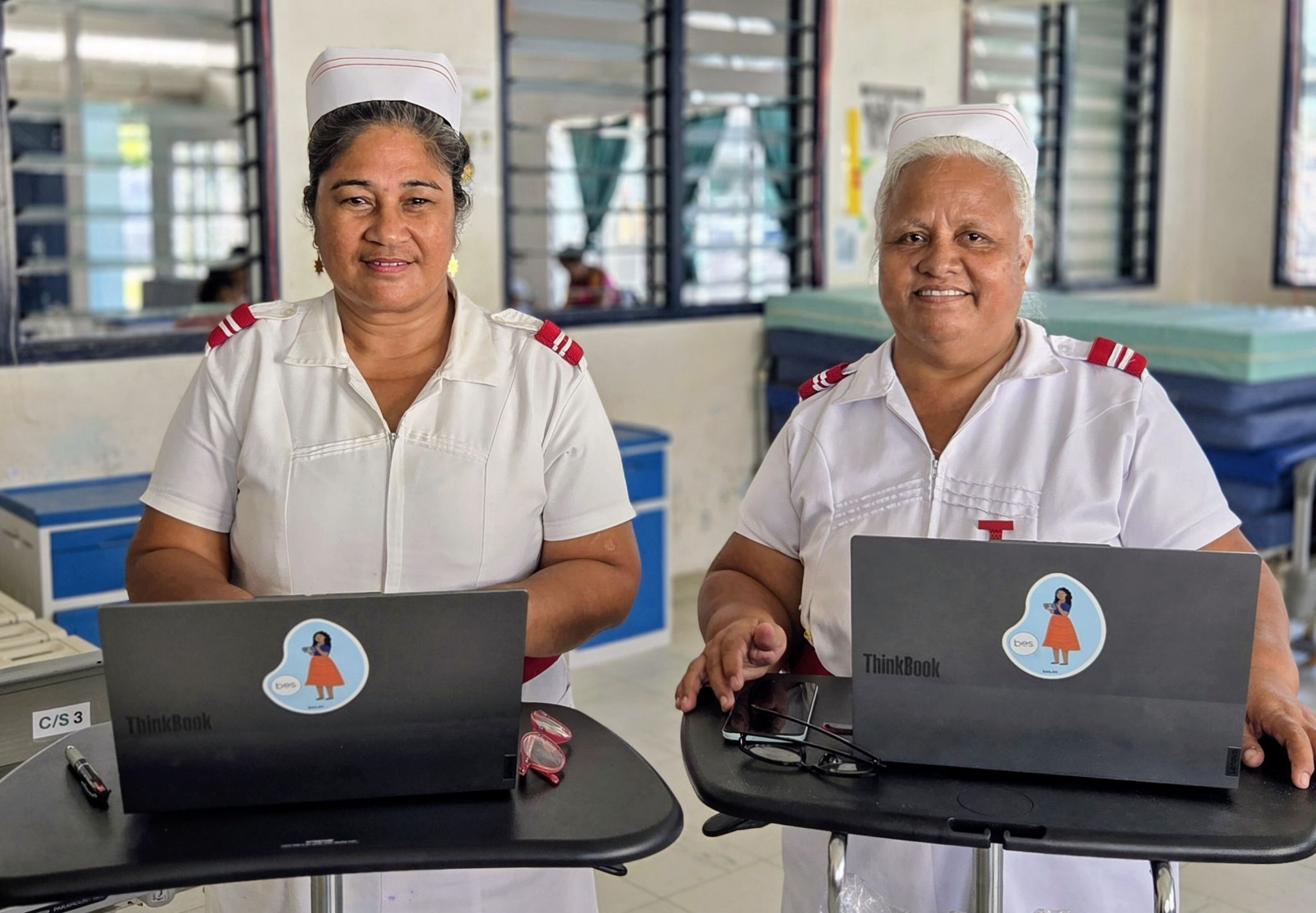
From left; Makite Neemia and Keeang Kararaiti, Sisters at the Tungaru Central Hospital in Kiribati using the new Maternal Health Care Program Registry in the Tamanu EMR.
Kiribati’s digital approach to maternal health care
The Obstetrics and Gynaecology Department at the Tungaru Central Hospital (TCH) in Kiribati are using a digital approach to better manage national maternal health care outcomes. In March 2026, the Department transitioned to using a digital Maternal Health Care Program Registry, embedded within their instance of the Tamanu EMR, giving healthcare workers instant access to patient information across two hospitals locations, and many remotely located clinics.
The implementation of the Registry empowers Kiribati midwives, nurses and doctors to access information of expecting mothers at any time of their journey, from the first antenatal care (ANC) appointment, through to delivery and post-natal care (PNC) in both Tungaru Central Hospital and Betio Hospital in Kiribati.
Pregnant women remain sadly vulnerable
Maternal health outcomes across Pacific Island Countries and Territories (PICTs) remain a significant concern. The WHO estimates that the maternal mortality ratio for the Pacific region was the second highest in the world as of 2020, at approximately 173 deaths per 100,000 live births (albeit with significant variation across PICTs). Despite some positive trends, there remains a substantial burden of preventable maternal and newborn deaths across the 22 PICTs, and reliable data are limited – creating real challenges for monitoring and improving care. High-risk obstetric conditions are a key driver of these outcomes. Hypertensive disorders of pregnancy – including pre-eclampsia, eclampsia, and HELLP syndrome (Hemolysis, Elevated Liver Enzymes, and Low Platelets) – represent a particularly dangerous spectrum of disease: pre-eclampsia (which can progress to eclampsia) and HELLP syndrome, together account for over 50,000 maternal deaths and more than 500,000 fetal deaths globally each year. Around the world, these conditions are most prevalent in lower-resource settings where access to quality prenatal care is limited, reflecting the key role that modern healthcare infrastructure plays in outcomes. Beyond hypertensive disorders, gestational diabetes – which is of particular relevance in the Pacific given the region’s high rates of obesity and non-communicable disease – postpartum haemorrhage, and maternal anaemia compound the risks faced by pregnant women across PICTs.
For conditions which require careful long-term management, such as preeclampsia and gestational diabetes, it is critical that data is managed longitudinally and is available immediately to all healthcare providers who come in contact with expectant mothers. For more acute conditions such as HELLP syndrome, that need escalates. Patients suffering acute conditions are often referred from primary halthcare facilities to tertiary facilities and the ability to avoid re-doing clinical examinations and diagnostics saves critical time. In the case of HELLP syndrome, those precious minutes and hours can literally save the mother’s life.
The solutions are not all digital – hospital capacity limitations, limited infection control tools, and other infrastructure challenges also remain common barriers to improving maternal and infant healthcare and the solutions are multi-factorial. Nevertheless, accurate clinical data collection is not just an administrative function – it is a critical tool for identifying at-risk patients, informing clinical decisions, and potentially saving lives.
Care across the ocean
In a country of 32 low-lying atolls spread across 3.5 million square kilometres of ocean, the challenge of managing continuity of care in Kiribati is very real. Kiribati’s health system relies on a small, dedicated health workforce and remotely located clinics. Before this digital approach was implemented, a mother who first visited the antenatal clinic and later presented to the emergency department or was admitted to the inpatient ward may not have had her earlier clinical notes. Important history – such as medications, previous visits or risk factors – could have been missed.
For the midwives, nurses and doctors managing both outpatient clinics and inpatient wards, fragmented patient information only adds to the pressure in already busy clinical environments. This seamless, digital approach not only makes each step of the maternal journey safer and more connected, but also empowers healthcare staff to deliver consistent and informed care to remote locations.
Having a patient’s medical history at their fingertips, health worker errors are minimised, and expectant mothers in Kiribati can confidently rely on a system designed to prioritise their wellbeing throughout pregnancy and childbirth. The Maternal Health Care Program registry is now being used by: ANC/PNC Clinics, ANC/PNC inpatients ward, Gynaecology clinic, and the Gynaecology inpatients ward.

The Obstetrics and Gynaecology Department within Tungaru Central Hospital (TCH) have a digital Maternal Health Care Program Registry
Expecting outcomes
The Department opted for a staged and gradual implementation of the software, allowing ample time for testing and staff capacity development, and have since accelerated their use.
Around 15 staff were trained in the Maternal Health Care Program Registry and provided with 5 laptops and 4 laptop trolleys. In the first week alone, around 45 patients were registered, supporting longitudinal care, regardless of where they seek treatment.
Tamanu will be used to manage patients in both pre and post-natal stages, including patients with gynaecological conditions and high risk factors. The Maternal Health Care Registry will be used to monitor patient care and management.
Tamanu also links patient records from the Emergency department and other inpatient wards for better history and management.
Potential impacts include:
? Enhancing Continuity of Care: Ensuring seamless data flow between outpatient clinics and the inpatients ward, as well as across multiple encounters and providers.
? Improving Patient Safety: Providing clinicians with real-time access to clinical history, reducing manual errors and providing an automated audit system.
? Data-Driven Decisions: Better health tracking for expectant mothers and more efficient ward management.
Tamanu is a free and open-source Electronic Medical Record, recognised as a global digital good for health. It is supported in Kiribati by the Government of Kiribati, MHMS, and the Australian Department of Foreign Affairs and Trade’s Global Health Division, through the Partnerships for a Healthy Region (PHR) Initiative.