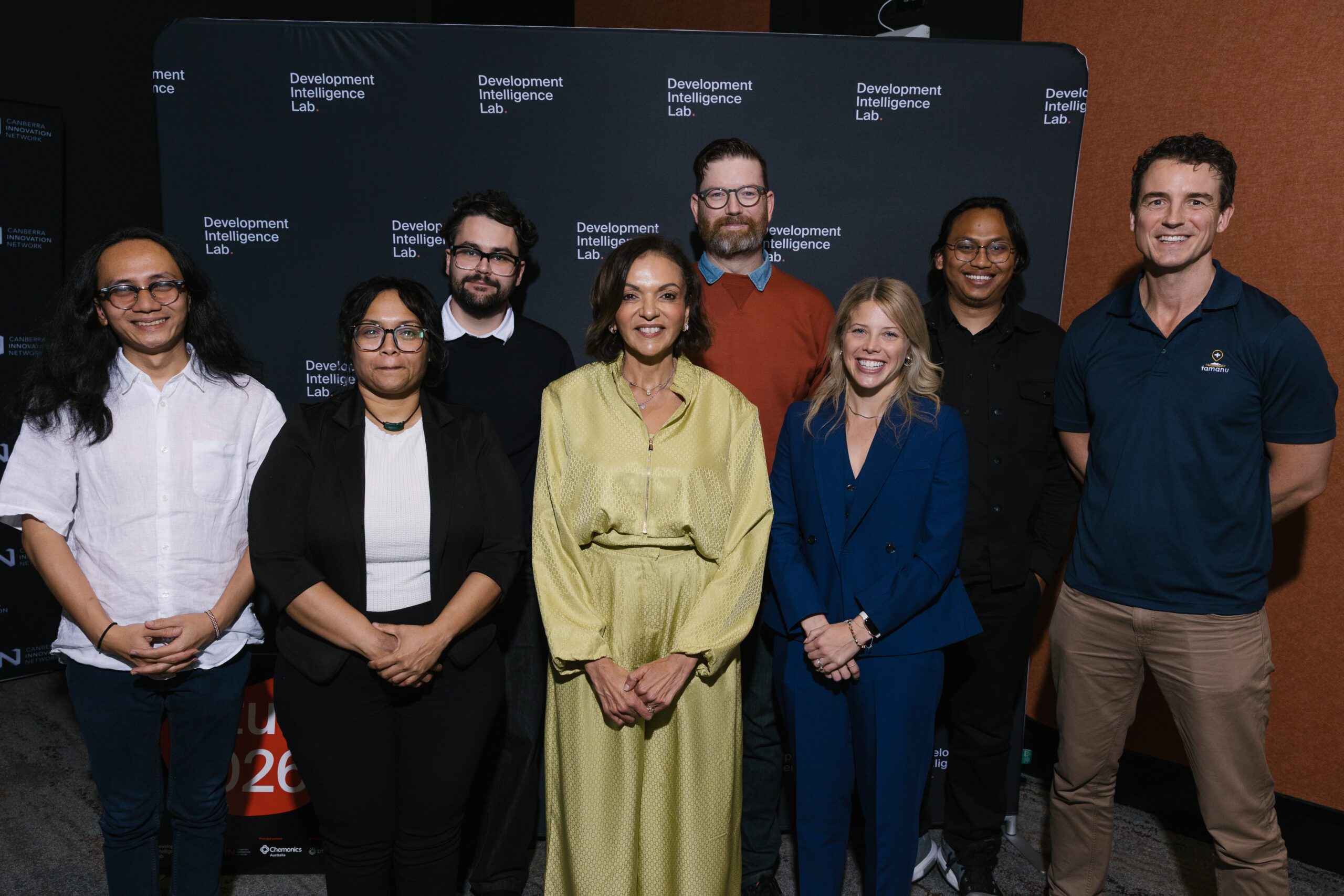
Last week, CEO Michael Nunan presented at Situation 2026, hosted by the Development Intelligence Lab. The event was centred on short ‘pitches’ from people who’d submitted a concept about AI used for good, that might help address international development challenges – think screening for TB, faster disease outbreak detection, or connecting local communities to funding.
You can read BES’s pitch here.
AI used for good
The point of the event was to get people with cracking ideas in the same room, with the ultimate purpose of trying to accelerate how AI is used for good, while being very mindful of the bad.
The group that emerged was a mix of AI experts, new experimenters and those simply curious. People from across Australia, Papua New Guinea, Palau, Tonga, Indonesia and Nepal. And from start-ups, government, NGOs and the private sector.
The vibe was the polar opposite of tech bro. There was a common purpose of trying to do good. Plenty of honesty about the limits of our knowledge. And a huge amount of positivity and encouragement.
There was an equal gender split of those who submitted ideas. An extremely diverse mix of countries and backgrounds. The organisers said they didn’t engineer this, the reality was even nicer – that those who are trying to use AI for good in international development are a truly diverse group.
We’ve summarised three of our favourite ideas / presenters in the room, including the first and second runner up (Asaria Sokove, and Jess Pollock) of the Pitch Challenge.
First place – Asaria Sokove with TokPeles AI
Asaria Sokove, who joined via video, took out both the inaugural Situation 2026 first prize as well as the people’s choice award. Asaria, from Lufa in Papua New Guinea’s Eastern Highlands, pitched TokPeles AI: a community-powered AI platform to preserve PNG’s 800+ languages for younger generations. In her words:
“This idea represents a dream I have carried for many years. Situation 2026 appeared at exactly the right time, providing the guidance and encouragement I needed.”
Runner up – Jess Pollock with Hold the Line
Rising seas are testing the legal sovereignty of Pacific nations like Kiribati, threatening the land and ocean titles that define a state. Young lawyer Jess Pollock Ross of Hold the Line will use AI to chart historical ownership of land and ocean mass. For nations whose economies run on fishing, keeping ocean rights after the land is gone isn’t abstract: it’s fundamental to economic survival. In her words:
“Taking home a prize, and the connections I made throughout the day, mean I can lift the idea off the ground and begin to shape an AI-verified Maritime Baseline Registry – stacking evidence behind coastlines.”
Showcaser – Katriel Healy and Simon Brock with Selma
AI is a heavy polluter, and being unregulated locks out anyone who can’t risk their data leaving the building – health workers, legal aid, disability and aged care providers, researchers and government. Katriel Healy, co-founder of EthicAI, was showcasing Selma alongside co-founder Simon Brock. Selma is an offline-first AI server with no data centre, no cloud, no water, running on next to no power. Selma is a values-driven and governance-first AI solution by design. It makes AI possible for the people who need it most, and have data worth protecting.
The great thing about Situation 2026 was the humble and brilliant people in the room, each sharing their concept about AI used for good. Collectively, the development challenges they contributed to solving in the Indo Pacific region were a reality, with many of the pitchers having launched and progressed their concepts into current projects. It was a privilege to attend and present, thank you to the Development Intelligence Lab for hosting such an inspiring event.
*Acknowledging Geordie Fung’s words from the Development Intelligence Lab whose follow-up LinkedIn post about Situation 2026 formed part of this article.